

We’ve been seeing these papers discussed a lot lately. Usually, the conversation goes in one of two directions: either AI is about to replace all human research, or synthetic respondents are fundamentally unreliable and we should stop using them.
We don’t think either conclusion is particularly useful.
At SYMAR, we build synthetic market research tools, so of course we have a perspective. But to be straightforward: the problems these researchers found are real. Compressed variation, stereotyping, overly rational answers and artificial agreement are not things we can wave away because a transcript sounds convincing.
The more useful question for us is: what exactly was tested, and what should we learn from it?
“Synthetic persona” is a broad label. It can mean a short demographic prompt, a digital twin built from hundreds of survey answers, or a participant in an ongoing group simulation. Those are different methods, with different assumptions. Throughout this article, we use synthetic personas, users and respondents as an umbrella for these simulated participants, while keeping the differences between implementations in view.
Our main takeaway is simple:
Methodology matters. But a more elaborate architecture still has to earn its credibility against human evidence.
Below, we look at four studies from 2025-2026: three published papers and one UCL preprint. This is a selected review, not a systematic review of the whole field. We chose them because they’ve prompted useful discussion and cover quite different ways of constructing and evaluating personas.
If you know research testing other approaches, particularly those compared with matched human data, please share it. We keep a broader academic research reading list as well.
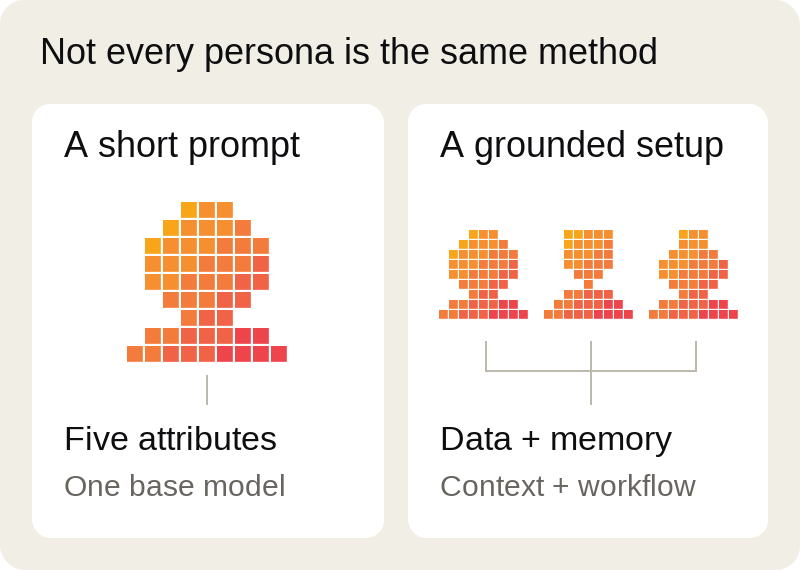
Different setups ask different questions. This is a schematic illustration, not a comparison of measured accuracy.
What the four studies actually tested
1. Batzner and colleagues: what do we mean by a persona?
Before comparing results, it helps to look at how researchers define their personas.
In Whose Personae? Synthetic Persona Experiments in LLM Research and Pathways to Transparency, Batzner and colleagues reviewed 63 peer-reviewed papers published between 2023 and 2025. The review was published at AAAI/ACM AIES in 2025.
Their concern was not simply whether persona prompts work. It was whether studies explain the task, the population being represented, and the relationship between the two clearly enough for their findings to be meaningful.
Only 35% of the papers discussed persona representativeness in their main text. Just 16% focused on domain-specific applications; the rest addressed personalization, robustness or bias and fairness. The authors also found that 60% used constructed interaction settings unlikely to reflect natural use.
That matters. A persona designed to test whether a chatbot follows a user’s stated preferences is not necessarily a model of a consumer making a purchasing decision. Nor does a convenient dialogue dataset automatically represent the population an insights team wants to study.
For us, the useful contribution is their transparency checklist: define the population, explain how the persona is grounded, and make the evaluation relevant to the intended use. Those are sensible requirements for vendors too, including us.
This review is not evidence that every academic persona is shallow role-play. It is evidence that the word “persona” often carries more meaning than the experimental specification can support.
2. Chen and colleagues: demographic patterns are not individual people
Chen, Wang, Wang and Bhatia’s Nature Human Behaviour study asked whether LLMs could reproduce economic preferences across 74 countries, using 67,201 matched respondents from the Global Preference Survey.
The preferences included risk-taking, patience, reciprocity, altruism and trust. The researchers tested 20 model configurations, including different models and robustness variants.
Their baseline personas contained five attributes: age, gender, self-assessed mathematical ability, region and country. The baseline used temperature zero to reduce randomness. Importantly, this was not an English-only experiment: prompts generally used respondents’ original survey languages, alongside English-only and other checks.
There was some signal. The models recovered the direction of demographic associations in 77.8% of the comparisons, but only 48.1% of cultural associations. Their predictions explained just 1.3% of individual-level variance and 4.2% of country-level variance.
Those are very different claims from saying that an LLM understands a particular person or reliably represents a country’s population.
A short demographic profile gives the model little information to distinguish people who share those attributes. Deterministic decoding can further reduce variation. But it would be too convenient to blame the entire result on temperature zero: the researchers also tested a higher-temperature configuration, and randomness is not the same thing as meaningful individual differences.
The authors are careful about scope. Their cultural-context ablations primarily used one persona-prompting design, and they note that richer cultural descriptions, retrieval or explicit calibration could behave differently. The original survey was also collected in 2012, creating both potential training-data exposure and a time gap with the models being evaluated.
We read this as a warning against treating demographic labels as a substitute for cultural and individual context. It is not proof that adding that context will solve the problem. That needs another experiment.
3. Peng and colleagues: more information helps, but not enough
The Science Advances paper by Peng and colleagues, Digital twins are funhouse mirrors: Five systematic distortions, tests a much richer setup.
Their Twin-2K-500 personas used each person’s answers to more than 500 questions: roughly 128,000 characters of demographics, personality measures, cognitive tests, economic preferences and other responses. The evaluation covered 19 preregistered studies, 164 outcomes and 1,784 unique human participants.
This is clearly more than a five-variable demographic prompt.
Rich profiles improved the correlation between simulated and human answers. Correlations were positive in 157 of 164 outcomes, or 95.7%, with an average of about 0.20.
That 95.7% figure is easy to misread. It means the correlations were positive across that share of outcomes, not that the twins gave the correct answer 95.7% of the time. And an average correlation of 0.20 is still weak.
The authors identify five systematic distortions:
- Insufficient individuation: synthetic answers varied less than human answers in 93.9% of outcomes.
- Stereotyping: responses remained too close to demographic expectations rather than the individual.
- Representation bias: some groups were predicted better than others.
- Ideological biases: the twins inherited systematic tendencies from the underlying models.
- Hyper-rationality: they often behaved more like capable analytical assistants than the people being represented.
The study also gives us useful implementation clues. A concise summary of about 13,000 characters performed very similarly to the full profile. Model and temperature changes did not remove the underlying limitations. More context did not automatically mean more fidelity.
There’s another result worth paying attention to. A supervised XGBoost model trained on the same profile information still achieved a predictive correlation below 0.29 with a training sample of 650 people. In this setting, the information itself limited prediction, not just the choice of LLM pipeline.
At roughly 180 training participants, the full-profile XGBoost benchmark reached a correlation comparable to the full-persona twins. That’s an interesting benchmark comparison, not a general claim that synthetic respondents replace a 180-person human study.
Our interpretation is that relevant data and how we use it both matter. A long personality inventory is not the same as knowing someone’s history with a product category.
But the paper does not isolate “attention dilution” or batch JSON output as the causes of the distortions. Those are hypotheses we could test, not established explanations. Similarly, its findings about this dataset do not establish a universal predictive ceiling for personality measures.
4. Perez and colleagues: plausible themes are not a human conversation
The UCL preprint by Laura Lara Perez, Paige Evans, Pia Schnabel, Teutly Correira and Joseph T. Devlin looks at a different problem: synthetic focus groups.
The authors compared 30 synthetic sessions with five human focus groups from the Macho Meals study, involving 22 UK men in total. Each original group was simulated three times under basic and enriched persona conditions. The authors have published their simulation code, benchmark and results.
Participant agents used Claude Haiku 4.5, with a Claude Sonnet 4.6 moderator. This was an interactive, multi-agent system, not a one-shot survey.
At the content level, the results were promising but incomplete. In the enriched condition, 78.8% of generated themes matched the human themes. Yet those groups recovered only 39.1% of the human thematic repertoire. The basic condition reached 71.0% precision and 27.0% recall.
Both measures matter. A discussion can stay mostly within plausible territory while missing much of what real participants would bring up.
The conversational differences were substantial:
- Enriched groups voiced 44.6% of their themes unanimously, compared with 14.9% in the human groups.
- Human group-level median turns were about 49 words; synthetic medians were around 240.
- Synthetic participants used fewer concrete food, brand and everyday references.
- In the enriched condition, identifying a speaker from their words was no better than chance: 32.5% correct against a 31.2% chance baseline.
The agents did receive their own previous responses and the conversation since their last turn. So calling them completely stateless would be inaccurate. They did not, however, have a separate memory store or private discussion notes.
The researchers deliberately avoided imposing human turn lengths or quotas for disagreement. Otherwise, they would have built some of the evaluation criteria directly into the simulation. That is an important point: making a model produce 49-word turns after measuring 49-word human turns would not, on its own, demonstrate conversational fidelity.
The preprint mentions SYMAR among commercial platforms, but it does not evaluate our platform or endorse our approach.
For us, the practical lesson is that useful thematic content and realistic group interaction are separate things. If the research question depends on disagreement, social influence or distinctive voices, a plausible transcript is not enough.
The common thread, without flattening the differences
Here’s how we would summarize the four studies:
| Study | What it examined | What we take from it |
|---|---|---|
| Batzner et al., 2025 | How 63 papers specified and evaluated personas | Define the population, grounding and intended task. |
| Chen et al., 2026 | Economic preferences from demographic personas across 74 countries | Broad demographic signal is not reliable individual or cultural representation. |
| Peng et al., 2026 | Rich survey-based twins across 164 outcomes | More profile information helps some comparisons, but substantial distortions remain. |
| Perez et al., 2026, preprint | Interactive groups under basic and enriched profiles | Thematic precision, coverage and conversational fidelity need separate evaluation. |
These are not four versions of the same one-shot experiment. They test different things, and the richer setups also encounter serious limitations.
Still, none of them evaluates every possible implementation of synthetic personas. That leaves a design space worth exploring. It doesn’t give any vendor, including SYMAR, permission to assume its own system is exempt from these findings.
What this means for SYMAR
For us, the response to these findings is not “write a longer prompt.” It is to be clearer about the research we want a simulation to support, the evidence behind it, and how we judge the result.
At SYMAR, three principles guide that work. The studies above inform our thinking; they do not validate our platform or prove that we have removed the distortions they observed.
1. Ground the research in relevant human evidence
More data is useful only if it is relevant to the decision.
A shopper’s category habits or previous product experience may tell us more about a particular question than another generic personality score. The starting point should be evidence about the audience and the market, not just a plausible biography.
Synthetic Memory and our custom model options let teams bring their own research and domain knowledge into SYMAR. These are ways to work with relevant material, not reasons to assume a simulation is accurate.
We should also be clear about where the information came from. Observed customer evidence and simulated responses are different things. Missing information should not quietly become an invented fact.
2. Make context and variation meaningful
Different people should not all sound like the same helpful assistant. But changing names, ages or writing styles does not, by itself, create meaningful differences between respondents.
The context has to matter to the research question. An experienced customer, a first-time buyer and someone who has recently switched brands may bring different concerns to the same concept. Whether a simulation captures those differences is something to evaluate, not infer from how convincing the profiles sound.
That applies to both synthetic surveys and synthetic focus groups. Useful variation is about the audience’s perspectives and behavior, not simply a more colorful transcript.
3. Validate for the decision at hand
A study exploring possible objections to an idea is not making the same claim as a study estimating how many people will buy it.
The evaluation needs to match that distinction. Are we assessing individual predictions, response distributions, thematic coverage or conversational behavior? A good result on one measure is not a pass on all the others.
For us, useful transparency means being clear about the audience, the evidence, the assumptions, the human comparison and the limitations. The important question is whether the simulation holds up on relevant tasks it has not already been calibrated to, not whether its explanation sounds impressive.
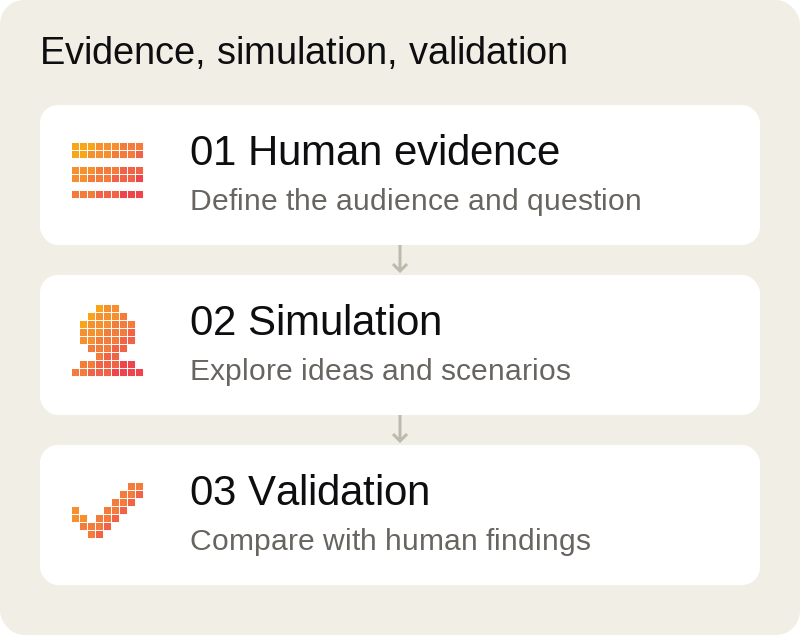
Evidence, simulation and validation: a general research process, not a diagram of SYMAR’s internal implementation or a claim of measured performance.
A small example: testing a subscription pricing page
Imagine a subscription brand testing three new pricing tiers. This is a hypothetical example, not a reported SYMAR study.
A short demographic prompt might produce a tidy explanation of which tier offers the best value. That could be useful, but it may say more about the model’s analytical ability than about how a busy customer would react.
Someone who has been caught out by an introductory offer may care most about the renewal price. A first-time subscriber might focus on what is included or how easy it is to cancel. Those are different perspectives on the same page, and relevant customer research can help us understand which ones deserve attention.
A team could explore those questions in a synthetic 1-on-1 interview or group discussion, then check the findings with real customers before making a pricing decision. It should not force a particular conclusion merely because a skeptical response sounds more realistic.
The point is to explore the decision with better context and clear assumptions, not just produce a more convincing character.
Why we welcome this research
We’re grateful to the researchers publishing this work. They give the industry something much more useful than another impressive demo: methods, comparison data and concrete failure modes we can investigate.
Our conclusion is not that synthetic research is ready to replace every human study. Nor is it that these papers close the door on behavioral simulation.
They show that we need to be specific. Which population? Which task? Which data? Which architecture? And what kind of validity are we measuring: individual prediction, distributions, thematic coverage or conversational behavior?
For insights teams, synthetic research can be a way to explore hypotheses, stress-test a guide and decide what deserves human follow-up. Its usefulness still needs to be established for the task at hand. High-stakes decisions and claims about real populations need appropriate human validation.
That’s the direction we’re taking at SYMAR: better grounding, more relevant context and clearer evaluation. Not a promise of perfect digital copies of people.
If you’re testing other research approaches, or have a paper we should read, we’d genuinely like to hear from you.
Talk to SYMAR about a research question you’re trying to answer, or explore our synthetic market research approach.
References and versions reviewed
- Batzner, J., et al. (2025). Whose Personae? Synthetic Persona Experiments in LLM Research and Pathways to Transparency. Proceedings of the AAAI/ACM Conference on AI, Ethics, and Society, 8(1), 343-354. Reviewed arXiv v1 of the AIES paper.
- Chen, F., Wang, Q., Wang, L., & Bhatia, S. (2026). Simulated responses from large language models are weak proxies for human economic preferences across 74 countries. Nature Human Behaviour. Published online 12 October 2026.
- Peng, T., et al. (2026). Digital twins are funhouse mirrors: Five systematic distortions. Science Advances, 12, eaeh8260. The figures discussed above come from the published paper. The supplied 2025 working paper, arXiv v3, is an earlier version with a different title.
- Perez, L. L., Evans, P., Schnabel, P., Correira, T., & Devlin, J. T. (2026). Where human similarity holds and where it breaks: Evaluating the alignment of synthetic focus groups. UCL preprint; reviewed the supplied version dated 1 November 2026. Source code, benchmark and results; supplementary information. These links point to supporting resources, not the preprint itself.